
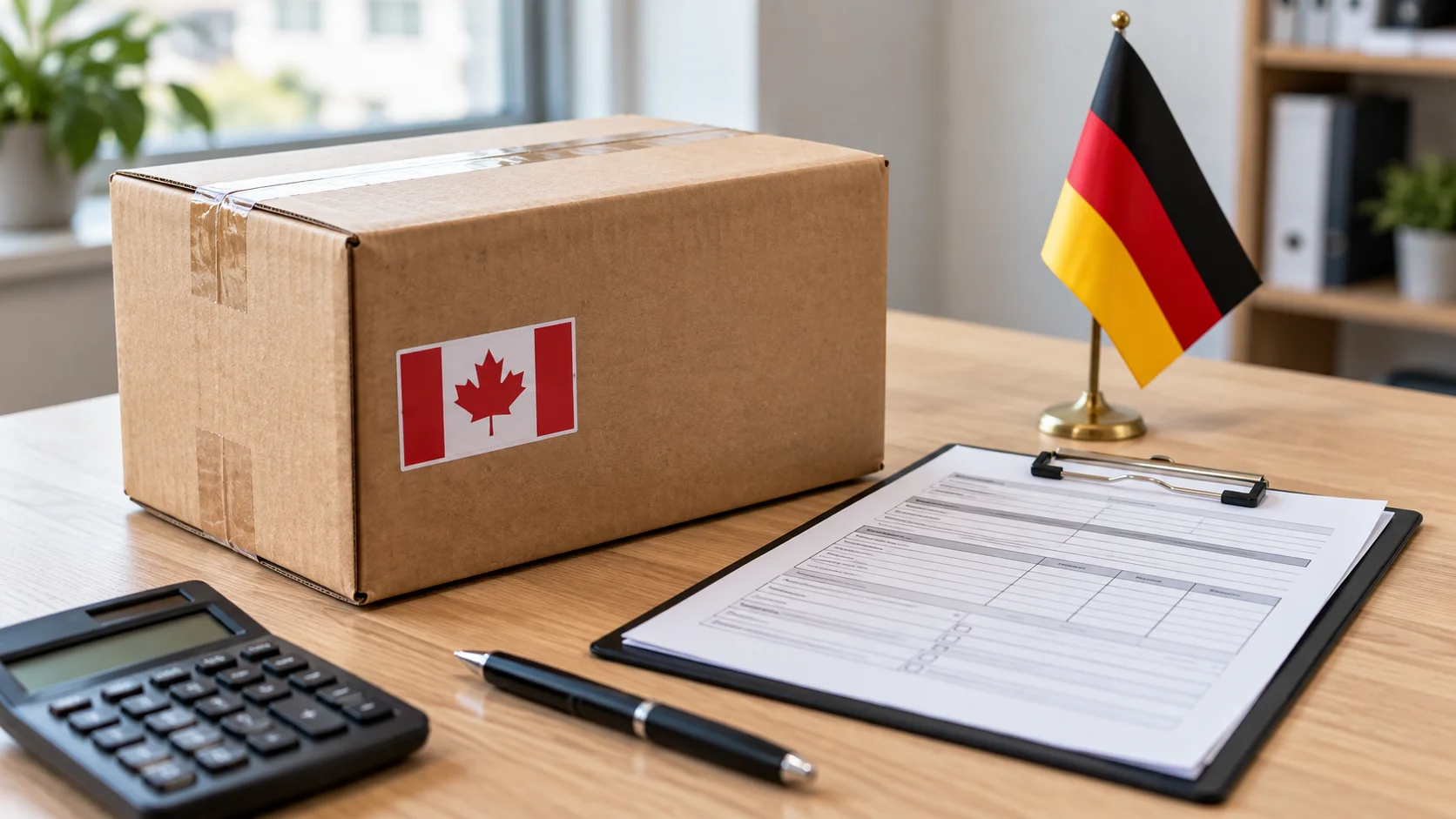
Every parcel from Canada to Germany clears German customs (the Zoll) on its way in. Whether your recipient pays anything depends on three things: what is inside, what it is worth, and whether it is a genuine gift, your own belongings or something that was sold. This guide explains the rules German customs applies today, as of October 2026, so you can declare your parcel correctly and your recipient is not surprised at the door.
The short version
- German import VAT is 19%, or 7% for items such as food and books.
- A genuine private gift worth up to €45 arrives free of duty and VAT.
- Since 1 July 2026 the EU no longer waives duty on goods worth up to €150. Online sales up to €150 now pay a flat €3 per item category plus VAT.
- Recipients normally pay import charges on gifts. For online sales, the €3 duty is normally owed by the seller, importer or their representative, and VAT may already have been collected at checkout.
- Meat and dairy, medicines, plants, cash and counterfeit goods should stay out of the box.
German import VAT: 19% or 7%
Germany charges import VAT (Einfuhrumsatzsteuer) on goods arriving from outside the EU. The standard rate is 19%. A reduced rate of 7% applies to certain goods, including many foods, books and newspapers. VAT is calculated on the customs value of the goods plus any customs duty, and German customs may include the shipping cost in that value when it is invoiced and declared.
German customs does not collect very small amounts: import charges under €1 on commercial shipments, and under €5 on gifts, are not levied.
Gifts: the €45 allowance and what happens above it
A parcel counts as a gift for customs only when all of these are true: it is sent by one private person to another, occasionally, for the recipient's personal use, and nothing is paid for it. A customer order, a reimbursement or an item you sold is not a gift, even if it is wrapped as one.
- Up to €45: free of customs duty and import VAT. The limit applies to the whole parcel, not to each item.
- Over €45 and up to €700: German customs can apply a simplified flat rate of 17.5% that covers duty and VAT together. For goods that qualify for a trade preference, the flat rate is 15%. For example, a gift worth €100 at 17.5% would cost the recipient about €17.50 in import charges, plus any carrier fee.
- Over €700: the normal duty rate for each type of goods applies, plus 19% or 7% VAT.
The gift allowance has its own limits for alcohol, tobacco, coffee and perfume, but Polimark does not ship alcohol or tobacco at all, so for most senders the €45 value limit is the one that matters.
Does Canada–EU free trade (CETA) remove the charges?
Partly, and only for duty. Under the Canada–EU trade agreement (CETA), goods that originate in Canada, meaning they were made in Canada under the agreement's rules, can enter the EU at a reduced or zero rate of customs duty. That is where the lower 15% flat rate for gifts comes from. CETA does not affect VAT: Germany still charges 19% or 7% on Canadian-made goods. Goods made elsewhere and simply shipped from Canada, such as most electronics and clothing, do not qualify.
The end of the €150 duty exemption (July 2026)
Until 30 June 2026, the EU waived customs duty on goods with a value up to €150 (VAT was already due on them). The EU abolished that exemption on 1 July 2026. In its place, goods worth up to €150 that are sold from outside the EU to consumers (online orders and other distance sales) now pay a temporary flat duty of €3 for each category of item in the parcel, on top of VAT. German customs gives the example of a parcel with four pairs of socks paying €3, and the same parcel with a plush toy and a charging cable added paying €9. The flat duty is scheduled to run until 1 July 2028, after which normal duty rates are expected to apply.
German customs has also announced a separate handling fee on these e-commerce parcels, expected from November 2026. Check the current rules before shipping goods you sell.
What this means if you are not selling
The €3 flat duty targets online sales. A genuine private gift is still assessed under the gift rules above, so the €45 allowance has not changed. In practice, the July 2026 change matters most if you sell to customers in Germany or ship goods someone paid for.
Gift, personal effects or commercial: choose the right type
Polimark's online customs form asks you to pick one of three shipment purposes. Pick the one that matches what is actually in the parcel:
- Gift: a present for a private person, sent without payment. Describe each item clearly, for example "Gift — Not for Resale — Children's books", and declare a realistic value.
- Personal effects: your own used clothing, household goods and other belongings. Used items are not automatically duty-free in Germany. If you are moving there, the separate relief for household goods on a change of residence has its own conditions and is not claimed on a parcel declaration; see our moving to Europe service for larger moves.
- Commercial (e-commerce): anything sold, ordered or paid for. Declare the full transaction value, include an invoice, and agree with your customer in advance who pays VAT, duty and fees.
What to put on the customs declaration
German customs relies on the electronic data sent with the parcel. Missing or vague details are the most common reason a parcel is held and the recipient has to deal with the customs office in person. Include:
- The full name, street address, postcode and city of both sender and recipient, plus the recipient's phone number and email.
- A specific description of each item: "women's wool sweater" or "paperback novels", not "clothes", "gift" or "personal items".
- The quantity, weight and value of each item, and the currency.
- The country where each item was made.
- The purpose of the shipment: gift, personal effects or commercial.
- For commercial shipments, the invoice or order confirmation, and the tariff (HS) code if you know it.
Declare the true value. Under-declaring to stay below €45 is illegal, and German customs can ask for a receipt or other proof of value. For used items, declare what they are worth now, not what you originally paid.
Who pays, and how the recipient pays
For private gifts that attract import charges, the recipient normally pays. The carrier that clears the parcel usually pays customs first and then collects the money from the recipient, often with a service fee on top. If the recipient refuses to pay charges they owe, the parcel can be held and eventually returned.
For online sales up to €150, the €3 duty is owed by the customs declarant, normally the seller, importer or their representative. The consumer is responsible only in exceptional cases. VAT may already be collected at checkout through the Import One Stop Shop (IOSS); when the shipment is correctly declared under IOSS, import VAT is not charged again at the border. Sellers should confirm the duty and VAT arrangements with their carrier before shipping.
When charges are payable by the recipient, collection depends on the carrier. Parcels that arrive through the postal network are delivered by Deutsche Post/DHL, which pays the charges to customs and collects them in cash at the door or at a branch, plus a €7.50 advance fee (Auslagepauschale). Recipients can avoid that fee by clearing the parcel themselves at a customs office, and it does not apply when no charges are due. If a parcel goes to a customs office instead, the recipient gets a written notice and has a limited time to collect it, and storage fees can start after 10 days.
When you are shipping parcels from Canada to Germany with Polimark, final delivery in Germany is handled by GLS. If the recipient owes charges, they are usually contacted, often by email, before delivery, which is another reason to include their email and phone number on the declaration.
Items German customs restricts or prohibits
Some goods that are ordinary in Canada are stopped at the German border. Leave these out unless you have confirmed the rules first:
- Meat and dairy: private parcels from Canada may not contain meat, meat products, milk or dairy products such as cheese, unless they meet the same veterinary requirements as commercial imports. Fish products are allowed up to 20 kg, and other animal products such as honey or eggs up to 2 kg per category.
- Medicines and supplements: private individuals generally may not import medicines into Germany by post or courier. Some supplements sold freely in Canada count as medicines in Germany. Polimark does not ship prescription medicines.
- Plants, seeds and cut flowers: these need a plant health certificate.
- Cash: do not send money in a parcel. EU customs can also require a disclosure declaration for €10,000 or more in cash sent by post or courier.
- Counterfeit goods: fake branded items are seized, even as a gift.
- Weapons and fireworks: including many knives and pepper sprays that are legal to buy in Canada.
- Unconstitutional symbols: material showing Nazi or other banned symbols, including some historical collectibles.
- Protected species: items made from protected animals or plants, such as ivory, need permits.
Polimark also does not ship alcohol, tobacco or cannabis. Our guide to European customs covers the rules that apply across the EU.
Practical tips for a smooth clearance
- Keep gifts simple. A parcel of clearly described gifts under €45 is the easiest case for customs. Don't split one valuable item or a sale across several parcels to stay under the limit.
- Tell the recipient in advance that a parcel is coming and whether they may need to pay import charges.
- Keep receipts for new items, in case customs asks for proof of value.
- Pack food in its original sealed packaging, and leave out anything containing meat or dairy.
- Ask before you ship anything unusual, from supplements to collectibles. Our team reviews customs declarations with you before your parcel leaves Canada.
Ready to send your parcel to Germany?
Drop your parcel off at any Canada Post location and we route it to Germany through our Calgary or Toronto hubs. Rates for a 5 kg parcel start at $71 by sea and $101 by air. Air takes 9-14 business days, and sea takes 7-9 weeks. Get an instant quote, see our Germany shipping rates and delivery details, or fill out your customs form online.
Official sources
Customs rules change. This guide reflects official sources as of October 2026 and is general information, not legal or tax advice. For a specific shipment, check with German customs or contact Polimark.
- German Customs (Zoll): gift consignments from non-EU countries (German)
- German Customs (Zoll): assessment of taxes and duties on postal consignments
- German Customs (Zoll): end of the €150 duty exemption from 1 July 2026 (German)
- European Commission (TAXUD): guidance on the temporary €3 duty on low-value imports
- Deutsche Post / DHL: import charges and the customs advance fee
- Government of Canada: Canada–EU Comprehensive Economic and Trade Agreement (CETA)